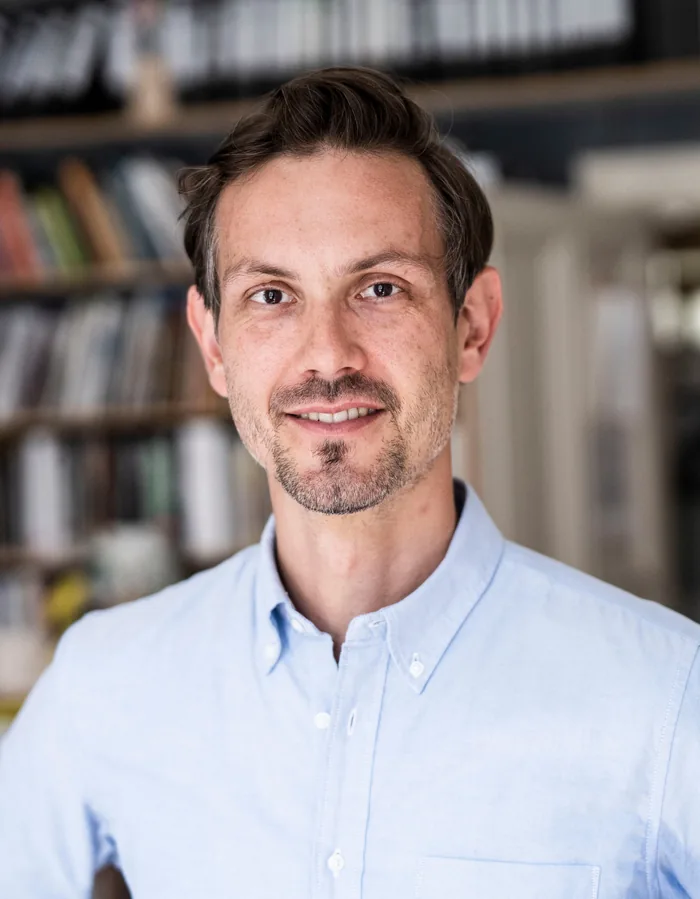
Prof. Dr. Benedikt Jahnel
Professor for Stochastics and Applications at Technische Universität Braunschweig and head of the Leibniz junior research group Probabilistic Methods for Dynamic Communication Networks at the Weierstrass Institute Berlin.
TU Braunschweig
Institut für Mathematische StochastikUniversitätsplatz 2, 38106 Braunschweig
Room 620, phone +49 (0)531 391 7569
Benedikt.Jahnel@tu-braunschweig.de
Weierstrass Institute Berlin
Anton-Wilhelm-Amo-Straße 39, 10117 BerlinRoom 502, phone +49 (0)30 20372 445
Benedikt.Jahnel@wias-berlin.de
Research interests
My research interests lie in the modelling and analysis of systems of many interacting random components that are spatially embedded. Those systems describe phenomena from physics, like liquid-vapour phase transitions, spatial epidemiology of communicable diseases, or peer-to-peer telecommunication in an urban environment. The goal is to derive and describe macroscopic states from highly complex microscopic system configurations. For this I use mathematical tools from statistical mechanics such as large-deviation theory and stochastic geometry to establish rigorous results. My work is sometimes supported by the comparison with real-world data and by computer simulations. It is presented to an international mathematical audience and researchers from related fields like engineering, life science and materials science.
Scientific team
Postdoc: Dr. Lukas Lüchtrath
Predocs: M.Sc. Yannic Steenbeck, M.Sc. Daniel Kamecke, M.Sc. Peteris Silins
Previous members: Dr. Jonas Köppl (now Universität Münster), Dr. Anh Duc Vu (now industry), Dr. Partha Ghosh (now Ruhr-Universität Bochum), Dr. Julia Hörrmann (now education), Dr. Sanjoy Jhawar (now Inria Paris), Dr. Alexander Hinsen (now industry).
I am available as a supervisor for bachelor and master projects within my research scope. If you are interested, please do not hesitate to contact me via email.
News
- Since October, our long-time team member Dr. Jonas Köppl is at the Universität Münster. We thank him very much for his many contributions and wish him every success.
- Interview for the popular-science magazine Spektrum on the recent supposed AI-generated proof for the percolation-function conjecture: KI löst bedeutendste Vermutung der Perkolationstheorie.
- We very much congratulate our team member Jonas Köppl on his successful PhD defense at TU Berlin on “On the long-time behaviour of interacting particle systems”.
- Workshop Spreading Dynamics in Random Environments at WIAS Berlin, July 6–8, 2026, co-organized with Dr. Lukas Lüchtrath and Jonas Köppl.
- It has been an honor to serve as an expert for the children’s podcast Kakadu – eure Fragen: Seit wann gibt es Mathematik und wer hat sie erfunden? at Deutschlandfunk.
- After a bit more than five years, our long-time team member at WIAS Anh Duc Vu left the institute. We thank him very much for all his contributions and wish him all the best for the future.
- It is our great pleasure to welcome M.Sc. Peteris Silins as a new member of the team at WIAS. Peteris earned his master’s degree in Groningen and will be working on information dynamics on random graphs, funded through the Berlin Cluster of Excellence MATH+.
- Mathematics at TU Braunschweig takes part for the first time with a lecture program in the Tag der Informatik und Mathematik.
News archive
- Our dear postdoc Dr. Partha Ghosh is leaving us for a new position at Ruhr-Universität Bochum in the group of Christoph Thäle. We wish him all the best and thank him very much for his great work at TU Braunschweig.
- Workshop on the occasion of Prof. Dr. Wolfgang König’s 60th birthday: Recent Developments in Spatial Interacting Random Systems at WIAS Berlin, October 15–17, 2025, co-organized with Prof. Dr. Hanna Döring, Dr. Willem van Zuijlen and Prof. Dr. Chiranjib Mukherjee.
- Call open for one predoc position in the project “Information Flow & Emergent Behaviour in Complex Networks”, co-PI’d with Dr. Lukas Lüchtrath, funded for three years within the Berlin Cluster of Excellence MATH+.
- Very happy to be nominated by our students at TU Braunschweig for the TU Teaching Award 2025.
- Success in the first call for proposals in the second phase of the Cluster of Excellence MATH+: our project “Information Flow and Emergent Behavior in Complex Networks”, co-PI’d with Dr. Lukas Lüchtrath, receives funding for one predoc position for three years.
- Lukas and Jonas from the WIAS team started the Postgraduate Online Probability Seminar (POPS), an online platform for doctoral students and postdocs from all over the world working in probability and its applications.
- Public talks at Mathematische Forschung verstehen at FU Berlin (June 19) and at the Hochschulinformationstag at TU Braunschweig (June 13).
- Public talk at the 28. Tag der Mathematik on May 10 at Berliner Hochschule für Technik.
- Elected member of the board of the Probability and Statistics Group of the German Mathematical Society, responsible for promoting young talent.
- Co-hosting the session “Spatial stochastics, disordered media, and complex networks” at the 17th German Probability and Statistics Days at TU Dresden together with Prof. Dr. Chinmoy Bhattacharjee.
- Workshop Stochastic Processes on Random Geometries at TU Braunschweig, February 17–21, co-organized with Prof. Dr. Sebastian Andres.
- We very much congratulate our former team member Alexander Hinsen on his successful PhD defense at TU Berlin on “Data Mobility in Ad Hoc Networks: Vulnerability and Security”.
- We very much congratulate our team member Jonas Köppl on his successful DAAD application that will bring him to UCLA for four months in spring 2025.
- We very much congratulate our team member Anh Duc Vu on his successful PhD defense at TU Berlin on “Percolation in Random Environments and Stochastic Homogenisation”.
- Very happy to welcome Daniel Kamecke as part of the applied stochastics team at TU Braunschweig.
- Together with Jonas Köppl we are organizing a contributed session on Gibbs Measures – Continuum and Discrete at the Bernoulli-IMS 11th World Congress in Probability and Statistics in Bochum.
- Three-day DYCOMNET workshop at WIAS Dynamic Spatial Random Systems featuring two minicourses plus eight international expert presentations.
- Call open for one predoc position in the group at TU Braunschweig.
- Call open for one postdoc position in the group at WIAS.
- Workshop Interacting Particles in the Continuum at Eurandom (TU Eindhoven), September 9–13, co-organized with Prof. Dr. Wioletta Ruszel and Prof. Dr. Frank Redig within the Eurandom Ambassador Program.
- Success in the final call for proposals in the Cluster of Excellence MATH+: our project on data transmission in dynamical random networks receives funding for one postdoc position for two years.
- Inaugural lecture at TU Braunschweig on September 19, 2023, as a joint event with my colleagues Prof. Dr. Nicole Mücke and Prof. Dr. Maximilian Merkert.
- Very happy to see our team member Jonas Köppl as a selected participant in this year’s 10th Heidelberg Laureate Forum.
- Minicourse on “Continuum Percolation in Random Environments” at the SPP summer school Probability and Geometry on Configuration Spaces.
- Our highlight article for the scientific report of the Weierstrass Institute is now available online: Probabilistic Methods for Communication Systems.
- Our group member Jonas Köppl has won the Dies Mathematicus Award for Best Talk from the Mathematical Institute of the Technische Universität Berlin.
- Very happy to welcome Dr. Partha Ghosh as part of the applied stochastics team at TU Braunschweig, and Dr. Lukas Lüchtrath as part of the DYCOMNET team at WIAS.
- Visit by Prof. Dr. Ni (University College London) and Prof. Dr. Wu (University of Strathclyde), funded via a joint application within the Lower Saxony – Scotland Tandem Fellowship Programme by the European Centre for Advanced Studies.
- Very happy to welcome Yannic Steenbeck as part of the applied stochastics team at TU Braunschweig.
- Contribution to the Studium Generale at TU Braunschweig on “Zufällige Geometrie und das Internet der Dinge” and lecture at the Schnupperstudium TU Braunschweig on “Die Poesie der Logik”.
- Very happy to welcome Jonas Köppl as part of the DYCOMNET team at WIAS.
- Successful applications for funding from the NETWORKS Center and the STAR Cluster for the workshop Recent Trends in Spatial Stochastic Processes together with Prof. Dr. Julia Komjathy and Dr. Pim van der Hoorn at Eurandom (TU Eindhoven).
- Our group member Jonas Köppl has won a Best DMV Student Talks Award from the Berlin Mathematical School and subsequently gave a presentation at the DMV Annual Meeting 2022 in Berlin.
- Popular science talk at the Lange Nacht der Wissenschaften Berlin on “Die Poesie der Logik” (video).
- Calls open for predoc and postdoc positions in the groups at TU Braunschweig and WIAS.
- Start of the professorship for Stochastics and Applications at Technische Universität Braunschweig, including a welcome interview.
- Article on percolation theory based on an interview with me and others in Spektrum der Wissenschaft: “Perkolationstheorie: Folgenschwer verknüpft”.
- Highlight article in the WIAS Annual Research Report 2021 on Probabilistic Methods for Communication Systems together with Alexander Hinsen.
- Workshop Random Point Processes in Statistical Physics at WIAS, co-organized with Prof. Dr. Wolfgang König and Prof. Dr. Hartmut Löwen within the SPP2265.
- Offer for a W2 professorship for Stochastics at the Philipps-Universität Marburg – declined.
- Very honored to become a EURANDOM Ambassador at Eindhoven University of Technology for four years.
- Happy to welcome our new team member Sanjoy Jhawar as a postdoc working in our group.
- Offer for a W2 professorship for Stochastics and Applications at the Technische Universität Braunschweig – accepted.
- Short presentation of the group in the Verbundjournal of the Forschungsverbund Berlin (07/2021, pages 34/35).
- Elected ombudsperson for good scientific practice at WIAS for three years.
- Successful defense of the habilitation at Technische Universität Berlin on “Stochastic Geometry and Communication Networks & Statistical Mechanics for Point Processes and Stochastic Dynamics”.
- Tenured position at the Weierstrass Institute.
- Kelsey Houston-Edwards interviewed me together with other experts for the cover story of the April edition of Scientific American: “The Mathematics of How Connections Become Global”.
- Happy to welcome our new team member Anh Duc Vu as a doctoral student working on dynamical percolation.
- Official start of the Leibniz Group Probabilistic Methods for Dynamic Communication Networks.
- Official release of our book Probabilistic Methods in Telecommunications in the Compact Textbooks in Mathematics series at Birkhäuser, together with Wolfgang König.
- Now part of the postdoctoral faculty of the Berlin Mathematical School.
Publications and preprints
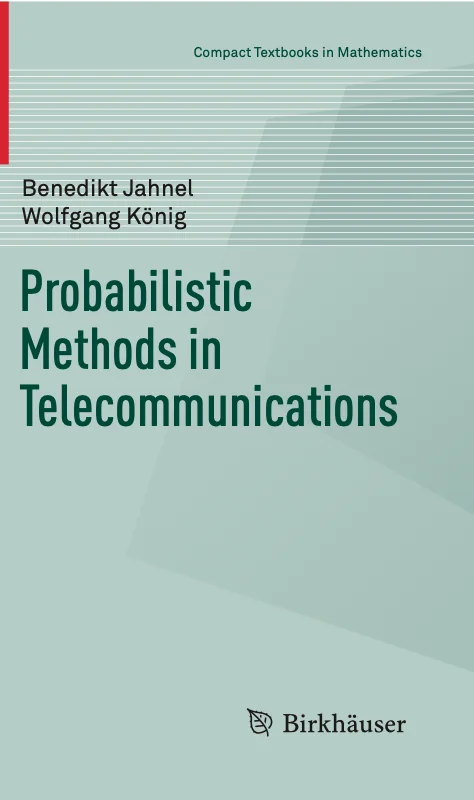
Book with Wolfgang König:
Probabilistic Methods in Telecommunications
Birkhäuser Compact Textbooks in Mathematics (2020).
Stochastic geometry
Preprints (6)
- Comparison inequalities for discrete- and continuous-time infection processes
- Convex order and faster transmission in first contact percolation
- Detection, coverage and percolation in dynamic Boolean models with random radii based on alpha-stable processes
- Local criteria for global connectivity comparisons: beyond stochastic domination
- Throughput in inhomogeneous planar drainage networks
- Phase transitions for contact processes on one-dimensional networks
- Coexistence for competing branching random walks with identical asymptotic shape on Z^d
- Phase transitions for contact processes on sparse random graphs via metastability and local limits
- The planar lattice two-neighbor graph percolates
- Cluster sizes in subcritical soft Boolean models
- A long-range oriented percolation model in random columnar time-space environment
- Functional limit theorems for edge counts in dynamic random connection hypergraphs
- Oriented bond-site percolation in random environment and contact processes with periodic recovery
- First contact percolation
- Subcritical annulus crossing in spatial random graphs
- Large and moderate deviations in Poisson navigations
- Poisson approximation of fixed-degree nodes in weighted random connection models
- Percolation in lattice k-neighbor graphs
- Stochastic homogenization on irregularly perforated domains
- An ergodic and isotropic zero-conductance model with arbitrarily strong local connectivity
- Chase-escape in dynamic device-to-device networks
- Connectivity in mobile device-to-device networks in urban environments
- Continuum percolation in a nonstabilizing environment
- Connection intervals in multi-scale dynamic networks
- Limiting shape for first-passage percolation models on random geometric graphs
- Absence of percolation in graphs based on stationary point processes with degrees bounded by two
- Sharp phase transition for Cox percolation
- Percolation and connection times in multi-scale dynamic networks
- Phase transitions for the Boolean model of continuum percolation for Cox point processes
- SINR percolation for Cox point processes with random powers
- Phase transitions for chase-escape models on Poisson-Gilbert graphs
- Lower large deviations for geometric functionals
- Exponential moments for planar tessellations
- Probabilistic methods for telecommunications
- Large deviations for the capacity in dynamic spatial relay networks
- Continuum percolation for Cox point processes
- Probabilistic methods for spatial multihop communication systems
- Space-time large deviations in capacity-constrained relay networks
- Large deviations in relay-augmented wireless networks
- Traffic flow densities in large transport networks
- Large-deviation principles for connectable receivers in wireless networks
Statistical mechanics
Preprints (6)
- Space-time large deviations for continuum birth-and-death processes
- Lattice random-field Widom-Rowlinson models
- Restriction and mixing properties of interacting particle systems with unbounded range
- Reversible birth-and-death dynamics in continuum: a de Bruijn-type identity for free-energy dissipation
- Reversible birth-and-death dynamics in continuum: free-energy dissipation and attractor properties
- Phase transitions for the Widom-Rowlinson model in random environments
- Locality properties for discrete and continuum Widom-Rowlinson models in random environments
- The variational principle for a marked Gibbs point process with infinite-range multibody interactions
- Time-periodic behaviour in one- and two-dimensional interacting particle systems
- On the long-time behaviour of reversible interacting particle systems in one and two dimensions
- Gibbs measures for hardcore-SOS models on Cayley trees
- Three-state p-SOS models on binary Cayley trees
- Trajectorial dissipation of Phi-entropies for interacting particle systems
- Dynamical Gibbs variational principles for irreversible interacting particle systems with applications to attractor properties
- A micro-macro variational formula for the free energy of a many-body system with unbounded marks
- Gibbsianness and non-Gibbsianness for Bernoulli lattice fields under removal of isolated sites
- Gibbsianness of locally thinned random fields
- Gibbsian representation for point processes via hyperedge potentials
- Phase transitions for a model with uncountable spin space on the Cayley tree: the general case
- Attractor properties for irreversible and reversible interacting particle systems
- Extremal decomposition for random Gibbs measures
- The Widom-Rowlinson model under spin flip: Immediate loss and sharp recovery of quasilocality
- Sharp thresholds for Gibbs-non-Gibbs transition in the fuzzy Potts models with a Kac-type interaction
- Attractor properties of non-reversible dynamics w.r.t. invariant Gibbs measures on the lattice
- A class of non-ergodic weak PCAs with unique invariant measure and quasi-periodic orbit
- Gibbsian and non-Gibbsian properties of the generalized mean-field fuzzy Potts-model
- Synchronization for discrete mean-field rotators
- A class of nonergodic interacting particle systems with unique invariant measure
- Phase transition and critical values of a nearest-neighbor system with uncountable local state space on Cayley trees
Wireless network architecture
Preprints (1)
- Multi-agent simulations for virus propagation in D2D 5G+ networks
- Absence of percolation in graphs based on stationary point processes with degrees bounded by two
- Agent-based simulations for coverage extensions in 5G networks and beyond
- Agent-based modeling and simulation for malware spreading in D2D networks
- Malware propagation in urban D2D networks
- The typical cell in anisotropic tessellations
- Percolation for D2D networks on street systems
- Disruptive events in high-density cellular networks
Outreach articles
- Challenges and opportunities of D2D networks
- Stochastic geometry in homogenization
- Probabilistic methods for communication systems
- Phase transitions of condensation type in interacting particle systems
- Probabilistic methods for mobile ad hoc networks
Theses
- Stochastic Geometry and Communication Networks & Statistical Mechanics for Point Processes and Stochastic Dynamics
- Gibbs Measures under Local Discretization and Rotation Dynamics
- The Central Limit Theorem for Random Walks in Markovian Environments
Teaching
Winter semester 2026/27
Lecture notes
- Risiko- und Extremwerttheorie (German, 69 pages, October 2026)
- Wahrscheinlichkeitstheorie und diskrete Finanzmathematik (German, 110 pages, October 2026)
- Ramp-Up Mathematics: Stochastics (English, 21 pages, October 2026)
- Probabilistic Methods in Telecommunications (English, with Wolfgang König)
Earlier courses
Summer semester 2026
Winter semester 2025/26
Summer semester 2025
Winter semester 2024/25
Summer semester 2024
Winter semester 2023/24
Summer semester 2023
Winter semester 2022/23
Summer semester 2022
Summer semester 2020
CV
Born May 28, 1980 in Saint-Martin-d’Hères (France).
- W2 professor for Stochastics and Applications, Technische Universität Braunschweig
- Head of the Leibniz Junior Research Group on Probabilistic Methods for Dynamic Communication Networks, Weierstrass Institute Berlin
- Habilitation, Technische Universität Berlin
- Postdoc at the Weierstrass Institute, research group Interacting Random Systems (Prof. Dr. Wolfgang König)
- PhD student at Ruhr-Universität Bochum, supervised by Prof. Dr. Christof Külske
- PhD student at Bergische Universität Wuppertal (Prof. Dr. Barbara Rüdiger)
- Studies in mathematics at Technische Universität Berlin, diploma thesis supervised by Prof. Dr. Jochen Blath
- Studies in music at City College New York, Master of Arts
- Studies in music education at Universität der Künste Berlin, diploma thesis supervised by Prof. David Friedman
Complete CV (PDF), last updated March 2025
Music
I am also a passionate piano player and composer in modern jazz. Please visit my music website.